
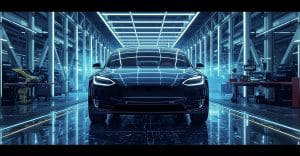
Tesla’s Q2 2026 shareholder update confirms Cybercab has entered production in Austin, with Tesla Semi volume manufacturing in Nevada and battery capacity expansion both on track for later this year.
It started with a single car rolling off a line in Austin, Texas. In mid-February 2026, Tesla publicly congratulated its team on completing the first production Cybercab at Gigafactory Texas — a two-passenger, fully autonomous electric vehicle with no steering wheel and no pedals. Not a prototype. Not a concept. An actual production unit.
That moment, quiet as it was, marked the start of something Tesla has been building toward since it unveiled the Cybercab concept in October 2024.
Tesla’s Q2 2026 shareholder update, released to investors, confirmed that Cybercab production is now underway at Gigafactory Texas in Austin, with a wider mass production ramp targeted from April 2026. The company also confirmed that Tesla Semi — its long-delayed electric lorry — remains on course for volume production at a new factory in Nevada later this year. Battery pack capacity expansion, identified by Tesla as a key manufacturing bottleneck, is also progressing.
A Robotaxi With No Wheel to Turn
The Cybercab is unlike any vehicle Tesla has built before. Designed exclusively for Tesla’s planned autonomous ride-hailing service rather than private ownership, it carries two passengers and is built around the assumption that no human will ever need to take control. There is no steering wheel. No accessible pedals. The vehicle is intended to drive itself, entirely.
Tesla has described the early production ramp as “agonisingly slow” — a phrase the company itself used, and one that will be familiar to anyone who followed the original Model 3 launch. Early automotive production runs are rarely smooth. Drone footage and observer reports from around Gigafactory Texas during March and April 2026 showed somewhere between 25 and 60 Cybercab units staged on site, consistent with validation activities including crash testing. Those numbers are visual estimates from third parties, not figures Tesla has officially confirmed.
What Tesla has confirmed is the ambition. The company has previously cited a long-term target of around 2 million Cybercabs per year once multiple factories reach full capacity. That figure comes from investor presentations and represents an aspiration, not a current production rate.
New Manufacturing Techniques Cut Paint Time From Hours to Minutes
One of the more striking details in Tesla’s update concerns how the Cybercab is actually made. The company is using a process called reaction injection moulding — RIM — for the vehicle’s exterior panels. Rather than painting body panels in traditional paint shops, RIM embeds colour directly into the material itself. Tesla says this cuts paint-cycle times from hours to minutes and reduces volatile organic compound emissions associated with conventional automotive painting.
It’s a meaningful shift. Paint shops are among the most expensive and environmentally intensive parts of any car factory. If Tesla can scale RIM effectively, it could change the economics of Cybercab production considerably.
Tesla Semi Moves Toward Volume Production in Nevada
The Tesla Semi has had a complicated history. First announced in 2017 with delivery targets that slipped repeatedly, the electric lorry has spent years in limited pilot production. Tesla’s Q2 update reaffirms that volume manufacturing is planned for 2026 at a new Nevada facility, building on earlier limited production elsewhere.
Elon Musk, Tesla’s chief executive, said during a prior investor call: “Semi is going to be a very important product for Tesla. The economics for operators are compelling.”
The case Tesla makes for Semi is straightforward — lower operating costs, reduced emissions, and a direct replacement for diesel lorries as freight operators face tightening environmental regulations. But analysts have noted the vehicle’s history of delays, and some remain cautious about the 2026 volume production timeline until actual output figures are published.
Deliveries Up 25% Year-on-Year
Across its full vehicle range, Tesla reported close to 480,126 global deliveries in Q2 2026 — a rise of around 25% compared with the same period a year earlier. That figure covers the company’s existing models and does not reflect meaningful Cybercab or Semi volumes, both of which remain at pilot production scale for now.
Battery pack output continues to be flagged as a constraint across Tesla’s operations. The company is investing in capacity expansion at multiple sites, including work related to its 4680-format cells, though specific gigawatt-hour output figures for 2026 have not been formally published in the Q2 summary.
What This Means for Kent Residents
For now, Cybercab production and Tesla Semi manufacturing are entirely US-based developments, and there are no confirmed plans for a Tesla robotaxi service operating in the UK. Any future deployment here would require approval from the Department for Transport and compliance with UK legislation on fully autonomous vehicles — a process that remains at an early stage. Kent residents with an interest in electric vehicles or autonomous transport will be watching how the regulatory picture develops nationally, while logistics and freight operators in the county may keep an eye on Tesla Semi as zero-emission alternatives to diesel lorries become an increasingly live commercial question.
Source: @Tesla
Tesla Cybercab Production Begins at Gigafactory Texas as Q2 Shareholder Update Outlines Semi and Battery Plans Quiz
5 questions