
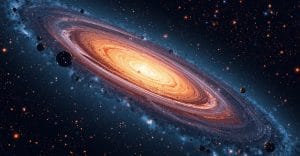
Over 20 supernova remnants in the Southern Pinwheel Galaxy are unexpectedly flickering in X-ray brightness, challenging what astronomers thought they knew about how stellar explosions fade.
When a star explodes, the blast is supposed to be the dramatic part. What comes after — the slowly expanding cloud of hot gas and debris known as a supernova remnant — was thought to be a quieter, more predictable affair: a gradual dimming over decades and centuries, like embers cooling after a bonfire. But new findings from NASA’s Chandra X-ray Observatory suggest that for some remnants, the fireworks are far from over.
Data gathered by Chandra while observing the spiral galaxy Messier 83, also known as the Southern Pinwheel Galaxy, has revealed that over 20 previously identified supernova remnants there are doing something they really shouldn’t be: flickering. Not fading steadily, but flaring up and dimming steeply in X-ray brightness in ways that don’t fit the standard picture at all.
A Galaxy Full of Stellar Explosions
Messier 83 sits about 15 million light years from Earth. To put that in some kind of perspective, one light year is roughly 9.5 trillion kilometres — so we’re talking about a distance that makes even the Moon feel like a short drive down the A2. The galaxy is a busy, star-forming spiral, which means it churns out massive stars at a high rate, and massive stars tend to end their lives in supernovae. That makes M83 a natural laboratory for studying what happens after stellar explosions.
Chandra has been watching. Astronomers analysed data collected over a 14-year period, from 2000 to 2014, tracking 22 X-ray sources associated with known supernova remnants in the galaxy. What they found surprised them. Roughly half of those 22 sources showed significant changes in X-ray brightness over the observation window — not the smooth, slow decline that models predict, but sharp, dramatic variations between different epochs of observation.
The findings were presented at an American Astronomical Society meeting and published in The Astrophysical Journal under the title “Variable X-Ray Sources Associated with Extragalactic Supernova Remnants.”
Why This Breaks the Rules
Here’s the thing about supernova remnants: once they’re older than around 100 years, the standard expectation is that they calm down. The hot gas expands and cools, and the X-ray glow fades at a steady, predictable rate. That’s the model. That’s what the textbooks say.
So finding remnants that flare and dim heavily — rather than fading quietly — is genuinely unexpected.
One remnant in M83 offers a possible clue. SN 1957D, the remains of a supernova first spotted in 1957, shows X-ray flares that researchers believe are caused by its expanding debris slamming into dense material surrounding the original explosion site. That collision heats the gas and produces bursts of X-ray emission. It’s a bit like a car hitting a patch of thick mud at speed — the sudden resistance causes a very different kind of splash than a smooth deceleration would.
But that explanation doesn’t cover all 22 sources. For many of the flickering remnants, the leading theory involves compact objects — black holes or neutron stars — left behind by the original explosion. If such an object is part of a binary star system, it can pull material from its companion star. That process, called accretion, is notoriously variable and can produce exactly the kind of erratic X-ray behaviour Chandra has been picking up.
Not Just an M83 Problem
NASA and the Chandra team have pointed out that similar behaviour has been spotted in other galaxies too, including M51, the Whirlpool Galaxy. So this may not be a quirk of M83 specifically, but something more widespread that earlier, shorter observations simply missed.
That’s partly what makes Chandra’s 14-year baseline so valuable. A single snapshot of M83 would show you the remnants as they appeared at one moment in time. Watching the same sources across more than a decade reveals patterns — and surprises — that you’d otherwise never catch.
The Center for Astrophysics at Harvard and Smithsonian has been involved in Chandra research, and the observatory itself remains one of NASA’s most productive space science missions, designed specifically to detect X-ray emission from extremely hot regions of the universe.
Rewriting What We Know
This research adds weight to the idea that supernova remnants are more complex and more dynamic than previously appreciated. It also raises questions about how remnants are classified and interpreted — if a source is flickering because of an accreting compact object, it might be misidentified in surveys that assume steady behaviour.
For astrophysicists, the work feeds into bigger questions: how do massive stars die, what kinds of compact objects do they leave behind, and how do binary star systems evolve after one of the pair explodes? These aren’t easy questions, and M83 is now offering some unexpectedly lively data to help answer them.
What This Means for Kent Residents
There’s no direct impact on daily life in Kent from this discovery, but the UK plays an active role in X-ray astronomy and space science, with researchers at universities across the country contributing to projects that use Chandra data alongside European missions. For local schools and colleges, the M83 findings make excellent real-world material for physics and STEM lessons — a vivid example of how long-term observation can overturn established theory. Kent’s astronomy societies and stargazing groups may well be discussing Messier 83 at their next public events.
Source: @NASA
NASA's Chandra X-Ray Observatory Finds Flickering Supernova Remnants in Galaxy Messier 83 Quiz
5 questions