
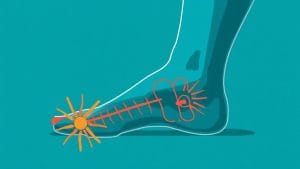
The New England Journal of Medicine has published a case report describing how a 46-year-old woman’s forefoot pain led clinicians to an unexpected finding in her upper leg.
The patient visited her GP with three weeks of pain in the front of her right foot. There had been no injury — the pain came on by itself, grew worse when she put weight on the foot, and hadn’t improved. A straightforward presentation, on the face of it.
What made the case notable was what imaging revealed. Rather than a problem at the site of the pain, a plain X-ray (radiograph) of the right proximal femur — the upper part of the thigh bone, near the hip — pointed clinicians toward a finding that explained the symptoms from a distance. The full imaging and diagnostic detail appears in the published case report.
The case illustrates something the NHS and medical educators regularly flag: pain felt in one part of the body can originate elsewhere. This is known as referred pain, and the foot-to-hip pathway is a recognised pattern in musculoskeletal medicine. Conditions affecting the hip or femur can produce sensations in the knee, thigh, or even the foot.
The New England Journal of Medicine, which published the case, is one of the world’s most widely read peer-reviewed medical journals. Its case record series is aimed at clinicians, though the reports are publicly accessible.
If you’re experiencing unexplained pain that isn’t linked to an obvious injury and doesn’t improve with rest, the advice from the NHS is to speak to your GP rather than waiting it out. They can arrange imaging or refer you to a specialist if needed.
Key information
- GP appointments: Contact your surgery if you have persistent unexplained pain, especially if it worsens with weight bearing
- NHS 111: Available 24 hours a day for advice if you’re unsure whether your symptoms need urgent attention — call 111 or use the NHS 111 online service
- Emergencies: Call 999 or go to A&E if pain is sudden, severe, or accompanied by swelling, numbness, or inability to bear weight
Source: @NEJM